
Every social media manager eventually opens a client's monthly export and sees reach down, engagement down, or a follower count that went flat for no obvious reason. The data isn't the hard part. Writing the paragraph that goes above it is.
Why a down month is hard to write, not hard to have
A down month happens to every account eventually — a platform algorithm shift, a slow posting week, a seasonal dip, sometimes nothing identifiable at all. That's not the failure. The failure is a report that either buries the number and hopes the client doesn't notice, or states it flatly with no read on what it means, which reads as indifference. Both erode trust faster than the number itself does.
The honest version — name the number, be straight about what you do and don't know caused it, say what happens next — is the one that keeps a client renewing. It's also the version almost nobody writes on the first draft, because it's genuinely easier to write a vague sentence than a precise one.
Don't hide it in an average
The most common bad habit is rolling a down metric into a wider claim it doesn't support — "overall engagement remained strong" next to a number that's down 30% from last month. Clients read reports closely exactly when the account matters to their business, and a client who checks their own Instagram app and sees the drop before opening your PDF stops trusting every other number in it, not just that one.
Name the metric, name the direction, name the actual figures. "Reach was 12,400 this month, down from 18,900 in August" is a sentence a client can act on. "Reach saw some fluctuation" is a sentence that makes them wonder what else got softened.
Don't guess at a cause you don't actually know
The second bad habit runs the other way: overcorrecting into a confident cause you haven't actually verified. "The algorithm deprioritized our content this month" is a real possibility, but stating it as fact when you haven't confirmed it is a claim you can't back up if the client asks a follow-up question.
If you know the cause — you posted less that month, ran a smaller ad budget, changed content mix — say that plainly, because you're the one source who actually knows it. If you don't know, say so and describe what you're checking, rather than inventing an explanation for a number just to fill the paragraph. "We're comparing this against posting frequency and platform-wide benchmarks before drawing a conclusion" is a more credible sentence than a guess dressed up as certainty.
Phrases that read as spin, and what to write instead
A handful of stock phrases show up in almost every softened report, and clients who've read a few months of these learn to spot them instantly. "Performance remained stable" next to a number that moved is the most common one — stable means unchanged, and a client checking the two figures will notice it doesn't. "We're seeing some fluctuation" is another: it describes every possible direction at once, which means it describes nothing.
"The algorithm changed" deserves its own callout, because it's true often enough that it gets used as a catch-all even when it isn't the actual cause. Platforms do adjust distribution regularly, but writing it as the explanation without having checked whether posting frequency, format mix, or a paused ad budget explains the month just as well is a guess wearing the outfit of an answer. If a client asks a follow-up — and the ones who read closely will — "I'm not certain, here's what changed on our side that could explain it" holds up better than a confident claim you can't defend.
The fix for all three isn't a better euphemism. It's specificity: the actual number, the actual comparison, and either the actual known cause or an honest "we don't know yet, here's what we're checking." A precise sentence about a bad month reads as competence. A vague one reads as something being hidden, even when nothing is.
The percentage math trap
There's a specific arithmetic mistake worth calling out on its own, because it looks harmless and isn't: comparing this month against a prior period that was itself incomplete. If last month's CSV only covered ten days because of when it was pulled, or a platform's export cut off partway through, the percentage change against it is real math on unreal numbers — a jump that reads as "reach up 33,000%" because the baseline was ten days of data, not thirty.
A client doesn't read that as good news. They read it as a mistake in the report, and now they're checking your other numbers too. If a comparison period looks partial — short by more than a few days, or clearly cut off mid-month — the safer move is to state the plain before-and-after figures without the percentage at all: "up from 194 to 65,210" tells the truth without implying a growth rate nobody would believe.
A structure that survives a bad month
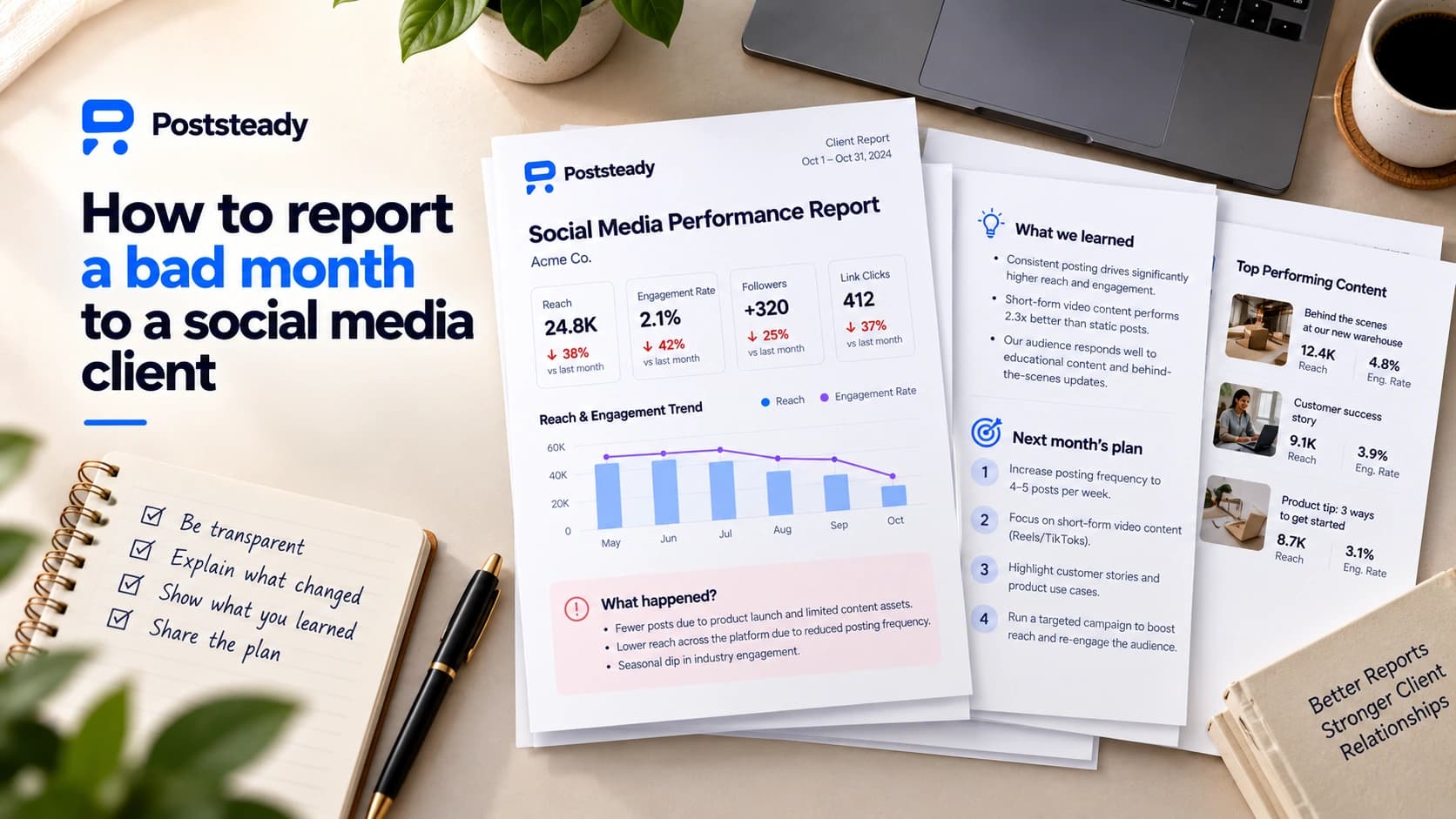
A report structure that works in a good month and a bad month, without needing to be rewritten for either:
- State the number and the direction, in plain figures, no softening language.
- State what you know about the cause — and only what you actually know, not what sounds plausible.
- State what you're doing next month, concretely enough that the client could check whether you did it.
That third line matters more than most reports give it credit for. A client who reads "we're adjusting posting frequency and testing two new content formats in October" has something to hold you to next month. A client who reads only the bad number has nothing but the bad number.
Where your own context is allowed to enter the summary
Numbers alone can't tell a client you ran fewer posts that month because you agreed on a slower content pace, or that a boosted post skewed the comparison. That context belongs in the report, but it has to be layered onto the real figures, not used to replace them — the numbers stay exactly what the export says, and your explanation sits next to them, clearly labeled as your read on the month rather than presented as another data point.
In Poststeady, that's a manager-context field you fill in per report before the summary gets written, and it's treated as background for the sentence, not a source of numbers — the AI drafting the summary is instructed to only use figures that appear in the data you uploaded, never invent one, and never quote a change flagged as an unreliable comparison off a partial prior period. It writes a first draft using your context and the real figures; you edit every line before it reaches a client. Nothing in the report is a number the model made up, and nothing is a sentence you didn't read first.
The one thing that makes this easier
The single hardest part of writing a down-month summary honestly is doing the arithmetic yourself while also trying to sound calm about it — pulling last month's number, this month's number, checking whether the comparison period is even complete, before you've written a word. Poststeady does that comparison for you: upload this month's export and last month's, and the report shows the change already calculated, with a flag on any comparison built off a period that looks partial, so you're not doing that math under deadline pressure while also deciding how to phrase it.
You still write the reasoning — what you know, what you're testing next. But you're writing it against numbers you can already see are trustworthy, instead of guessing at both the math and the message in the same sitting.
Write the honest version faster
Upload this month's export and last month's — Poststeady flags any comparison that isn't safe to quote before you draft a word.